

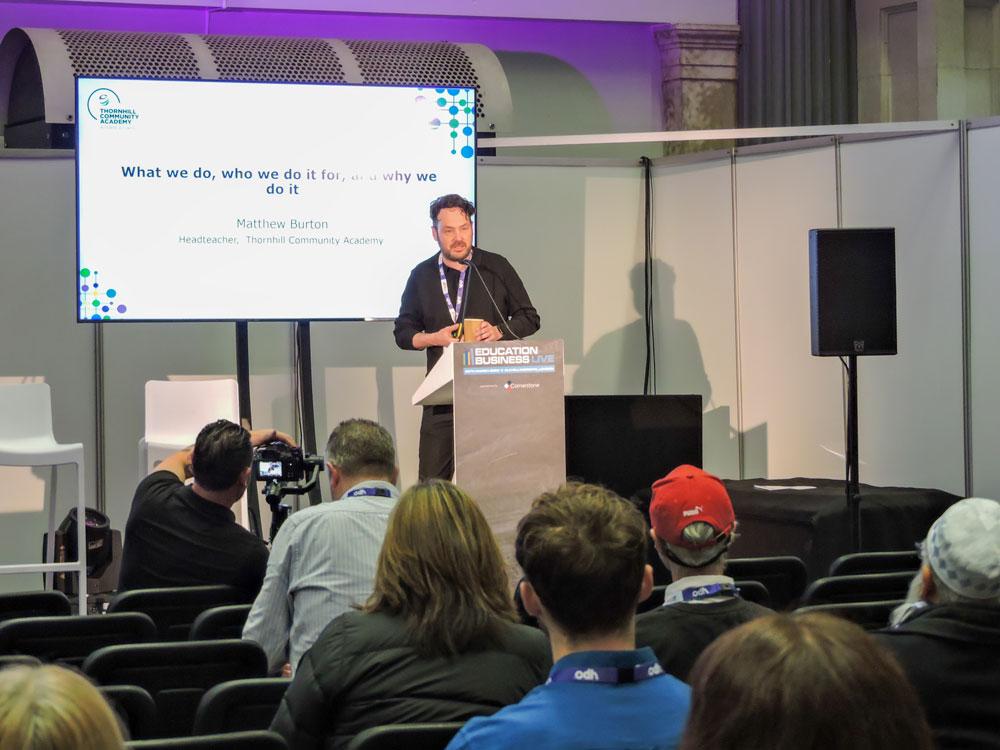
The second Education Business LIVE Conference & Exhibition took place at London’s Old Billingsgate on 26 March with an ambitious programme tackling some of the most pressing issues facing education - from SEND reform and teacher training to artificial intelligence and school inspections.
Bringing together school leaders, trust executives, policymakers and suppliers, the one-day event delivered a comprehensive mix of keynote speeches, panel discussions and practical sessions, alongside a vibrant exhibition floor and the co-located Education Business Awards.
A strong focus on leadership and strategy
The conference opened with a keynote from Matthew Burton, known for Channel 4's Educating Yorkshire, who reflected on his leadership journey at Thornhill Community Academy.
Matthew emphasised the importance of embedding a strong school ethos at the heart of every staff member’s practice, while also recognising the human side of teaching. He highlighted the need to understand individual personalities and actively support staff wellbeing, particularly on the challenging days the profession inevitably brings.
His address set the tone for a programme heavily focused on leadership, operational effectiveness and system-wide improvement.
An early session brought together Stephen Morales of the Institute of School Business Leadership and Emma Balchin of the National Governance Association, who explored how schools can build effective organisational structures. Their discussion emphasised the importance of clear processes, strong leadership and robust productivity monitoring.
Later sessions, including contributions from Astrea Trust CEO Rowena Hackwood, and Dr Mary Bousted, Chair of the Teaching Commission, examined how leadership frameworks translate into day-to-day practice, offering insights from across multi-academy trusts.
SEND and inclusion high on the agenda
Special educational needs and disabilities (SEND) provision emerged as one of the event’s central themes. Sessions brought together voices from across the sector, including Samantha Twiselton of Sheffield Hallam University, who discussed the current SEND landscape and what schools can expect going forward.
Heba Al-Jayoosi, assistant headteacher and inclusion leader at Mayflower Primary School, shared practical insights on integrating SEND learners and Ali Durban MBE, co-founder of Gesher School, spoke about her experiences as a SEND parent and establishing a specialist school in London.
With the government investing £3.7 billion to create more accessible school buildings and put in place Inclusion Bases, Terry White, chair of the Association for Learning Environments, gave practical advice on implementing inclusive design in mainstream schools.
The speakers then re-joined for a panel discussion which combined policy context with practical application, covering inclusive classroom design, mainstream integration and system-wide challenges.
Adam Sproston, Senior His Majesty’s Inspector, SEND and Inclusion, at Ofsted, took an afternoon session to provide insight into how SEND will feature in new inspection frameworks. He explained how inspections will look and feel different, with context further taken into account, a more collaborative approach, a clear focus on wellbeing, and clear recommendations on what to do to improve.
Teacher training and workforce development
Teacher recruitment and retention were addressed through sessions led by James Coleman of the National Association of School-Based Teacher Trainers, alongside further contributions from Samantha Twiselton.
A clear message emerged: the need to balance rigorous training with the development of “human skills” such as emotional intelligence and problem-solving, which are seen as critical to long-term teacher retention and classroom success.
Practical solutions
Beyond policy and pedagogy, the event placed strong emphasis on operational challenges. There was a session on procurement, featuring contributors including Kevin Draisey, Head of Procurement Operations for the DfE's Get help buying for schools. Kevin offered practical advice on improving efficiency and reducing financial risk.
Other speakers included David Kershaw, government advisor and digital transformation specialist; Peter Melville, chief operating officer at South West Essex Community Education Trust, Jack Horton, customer engagement manager at Crescent Purchasing Consortium, and Clare Delaney, managing director at Place Group.
Estates management was another key focus, with a theatre session delivered in partnership with the National Alliance of School Premises Management and sponsored by Cornerstone.
Stuart McGregor, NASPM’s director of operations and Chris Coyle, NASPM’s operations manager, alongside headteacher Paul Jackson, spoke about compliance, health and safety responsibilities, and risk management - highlighting the often complex realities of maintaining school infrastructure.
MAT inspections and flexible working
With multi-academy trust (MAT) inspections on the horizon, a dedicated session explored how trusts can prepare without increasing administrative burden. Speakers including
Warren Carratt, CEO of Nexus Multi Academy Trust, Rowena Hackwood, CEO of Astrea Trust, Gail Brown, CEO of Ebor Academy Trust, and Rebecca Daulman from Agora Learning Partnership, emphasised readiness, impact and proportionality over compliance-driven approaches.
Flexible working also drew significant attention, reflecting wider workforce pressures.
Speakers included Kelly Hannaghan, director at Mind Work Matters; Emma Wigmore, chief executive officer at The Diocese of Chelmsford Vine Schools Trust, Dr Mary Bousted, Chair of the Teaching Commission, and Warren Carratt. They discussed how schools can balance staff wellbeing with operational needs - an issue increasingly shaping recruitment and retention strategies.
AI and digital transformation take centre stage
Artificial intelligence and education technology formed one of the most forward-looking strands of the conference. Delivered in partnership with techUK, sessions explored how schools can adopt AI tools safely and effectively.
Opening remarks came from Austin Earl, education & EdTech lead at techUK and chair of the EdTech Advisory Panel on AI in Education, who explored how research-led certification can help schools adopt AI tools with confidence, ensuring they are safe, effective and ethically grounded.
Speakers included Rob Peters from the NGA, Chris Goodall, head of digital education at the Bourne Education Trust, and Dr Madiha Khan, director of consulting services at EDUCATE Ventures Research. The session was chaired by Edtech legislator, Jim Knight, The Rt Hon Lord Knight of Weymouth.
Alongside this, a session on digital maturity examined how education leaders, government and industry partners can work together to drive coherent progress. Contributors included Elizabeth Anderson, CEO of the Digital Poverty Alliance, and Cheryl Shirley, director of digital learning at LEO Academy Trust.
Austin Earl also chaired a panel session which considered how the education sector can respond to the challenges of digital transformation at a time of fragmentation, funding pressures and rising expectations.
A talk on building AI-ready teams for better student support services also took place, in association with consultancy redk. This allowed delegates to watch first-hand how AI helps solve common student problems quickly while making management easier.
School food and pupil wellbeing
School food policy also featured at Education Business LIVE, with sessions addressing anticipated updates to standards and expanding provision.
Trisha Jaffe, chair of the Osborne Co-operative Academy Trust, whose former school featured in the original Jamie’s School Dinners documentary in the early noughties, spoke about her experience of the show and how it sparked the revolutionary improvement of school food
Myles Bremner, CEO from Bremner & Co and former director of the government’s School Food Plan, gave the policy context about what’s changing in school food, as well as expanded Free School Meals and breakfast provision expansion.
Exhibition, networking and sector innovation
Alongside the conference programme, the exhibition floor showcased a wide range of suppliers spanning technology, facilities management, catering and SEND provision. Live demonstrations and networking opportunities provided delegates with practical insights and opportunities to share best practice.
Roundtable discussions added a more interactive element, allowing smaller groups to explore topics such as wellbeing, sustainability and inclusion in greater depth.
Celebrating excellence
The day concluded with the Education Business Awards, now in its 17th year, recognising excellence across more than twenty categories. Hosted by Educating Yorkshire's Matthew Burton, the ceremony celebrated achievements in leadership, SEND provision, technology and school operations. See the full list of winners here.