

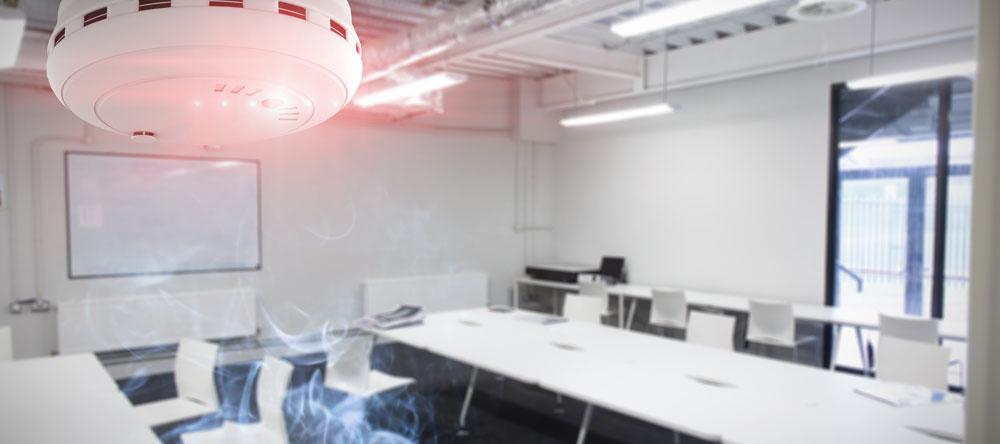
A school fire can have consequences that last long after the flames are out. Phil Garrigan, chair of the National Fire Chiefs Council, looks at the existing and evolving fire risks facing schools, and makes the case for the greater use of sprinklers to protect both lives and education
When we talk about fire safety in schools, the conversation understandably centres on protecting the lives of pupils, staff and visitors. That must always remain the first priority. It is, however, not the only measure of success.
Thankfully, schools are generally low-risk environments for fire and deaths or serious injuries are rare. Robust evacuation procedures, fire alarms and well-rehearsed emergency plans all play an important role in keeping people safe. Yet when a school is damaged or destroyed by fire, the consequences can extend far beyond the immediate incident.
Children can be displaced for months while alternative accommodation is found, families face disruption to their daily lives and communities can lose an important local asset. In some rural areas, pupils may have to travel considerable distances to the nearest available school, while those attending specialist settings may have no suitable local alternative.
The Covid-19 pandemic showed just how important it is to minimise disruption to education wherever possible. While the circumstances are very different, losing a school to fire can have lasting consequences for pupils, families and staff, particularly where suitable alternatives are limited.
Fire safety in schools should therefore be measured not only by whether everyone gets out safely, but also by whether the school can continue serving its community afterwards.
Understanding evolving fire risks
Delivering that level of resilience depends on understanding how fire risks are changing and ensuring school buildings continue to adapt alongside them.
The increasing use of solar panels across the education estate is one example of how fire risk continues to evolve. They can make an important contribution to reducing emissions and improving energy efficiency, and their use is likely to continue grow.
As with any significant change to a building, they should be accompanied by careful planning and ongoing management. Fire and rescue services take any emerging fire risk seriously, and it is important that solar installations are designed, installed and maintained properly, with fire risk assessments reviewed to reflect any changes to the building.
Schools also continue to face more traditional risks, with arson still accounting for a proportion of fires in educational settings. In 2022/23, fire and rescue services in England attended 522 fires in educational premises, of which 95 were recorded as deliberate fires. This was substantially lower than in 2010/11, when 855 fires were recorded, including 215 deliberate incidents. This long-term reduction is welcome, but nearly one in five of the fires recorded in 2022/23 was still started deliberately.
While the number of deliberate fires has fallen over the past decade, they remain a reminder of the importance of good site security, identifying areas where deliberate fire-setting is more likely and working with local fire and rescue services to reduce those risks.
Minimising the impact
Whether a fire is accidental, deliberate or linked to changes in the built environment, schools cannot eliminate every potential source of fire. What they can do is ensure that, when a fire does occur, it is far less likely to become a devastating one. Automatic fire suppression systems, most commonly sprinklers, are one of the most effective ways of achieving that.
The greatest benefit of sprinklers is their ability to control a fire in its earliest stages. In a school, that can mean the difference between the loss of a classroom and the loss of an entire building. By containing a fire to the room where it starts, they minimise damage, reduce disruption and help schools return to normal as quickly as possible.
Sprinklers also make a significant difference to the operational response. By controlling a fire before crews arrive, they reduce the risks firefighters face, limit the number of resources required and help ensure fire and rescue services remain available for other emergencies.
Real-world examples consistently demonstrate the value of sprinklers in schools. In 2017, Dorset & Wiltshire Fire and Rescue Service attended a fire at a school without sprinklers. On arrival, firefighters were faced with a well-developed blaze that caused extensive damage to the classroom block. While crews prevented the fire from spreading further, the impact on the school was significant.
A few years later, the same fire and rescue service attended a similar incident at a primary school protected by sprinklers. Before firefighters arrived, a single sprinkler head had activated, containing the fire to the room of origin and preventing significant smoke and fire damage. The school was able to reopen after only a short period while minor repairs were completed.
This is not an isolated example. Fire and rescue services have repeatedly seen sprinklers contain or extinguish fires before they can develop beyond the room where they started, helping to protect school buildings, reduce disruption and preserve vital community assets.
NFCC has consistently called for automatic water suppression systems to be installed in all new schools and in existing schools undergoing major or significant refurbishment. The evidence is clear, and the operational experience of fire and rescue services across the UK reinforces it.
However, we remain concerned about the direction of policy in England. Building Bulletin 100 (BB100), published in 2007, recognised the importance of sprinklers by stating that all new schools should have them installed, except in a small number of low-risk buildings. More recent proposals consulted on in 2021 moved away from that approach, limiting the expectation to certain types of school, including those above an 11-metre height threshold.
Our response to this consultation was clear: fires do not discriminate by building height.
Very few schools exceed 11 metres, meaning the proposed threshold would have applied to only a handful of new buildings while significantly weakening the previous expectation for sprinkler protection.
Greater clarity is needed
More recently, the Department for Education’s Technical Manual has created further uncertainty by stating that the 2007 version of Building Bulletin 100 (BB100) is no longer required, despite it not having been formally withdrawn. The result is a less consistent approach to sprinkler provision at a time when in fact greater clarity is needed.
School buildings should be designed with resilience in mind. Protecting the people inside them will always be the first priority, but protecting the continuity of education should be part of that thinking from the outset.
Scotland and Wales have already recognised this by requiring sprinklers in all new schools, regardless of height. That approach is supported by organisations from across the education, insurance, construction and fire sectors, and it is one England should follow.
We understand that decisions about school design must balance a range of priorities, from educational needs to sustainability and affordability. But resilience should be one of them. Once a school has been lost to fire, the educational, financial and social costs far outweigh the investment needed to reduce that risk in the first place.
Fire safety in schools should not be judged solely by whether everyone escapes safely. It should also be judged by whether children can return to learning, staff can return to work, and communities can continue to rely on the buildings they depend upon.
We cannot prevent every fire, but we can reduce the damage it causes. That is why NFCC will continue to advocate for school buildings that are designed not only to protect life, but to protect education itself.
Read more at www.nfcc.org.uk