

The DfE’s new Education Estates Strategy signals an important change in how estates will be planned, funded and managed. Jackie Maginnis, chief executive of the Modular and Portable Building Association, considers how volumetric modular technology not only aligns with the strategy’s four key pillars, but can be fundamental in delivering change
Rather than focusing solely on replacing ageing buildings, the Education Estates Strategy promotes a more enduring approach to creating a resilient, sustainable and high-performing estate that supports educational outcomes whilst delivering long-term value for taxpayers.
Whilst the strategy does not prescribe a preferred construction methodology, volumetric modular construction is uniquely positioned to help deliver many of its objectives. By combining offsite manufacturing methods with digital design and industrialised production techniques, modular construction offers an opportunity to rethink how educational buildings are delivered. Not simply as projects, but as long-term assets that can evolve alongside the needs of pupils, educators and communities.
A new approach to educational infrastructure
School construction has often been characterised by lengthy programmes, weather related delays, escalating costs and significant disruption to occupied campuses. The Education Estates Strategy challenges the sector to move beyond this traditional approach by placing greater emphasis on proactive estate management, quality, sustainability and whole-life performance.
Volumetric modular construction aligns naturally with this strategy. Rather than constructing buildings almost entirely on site, volumetric manufacturers complete three-dimensional building modules within a controlled factory environment. These modules can arrive on site with much of the internal fit-out already complete before being craned into place. This industrialised approach allows construction to become more predictable, more efficient and significantly less disruptive whilst maintaining the architectural quality and performance expected of modern educational facilities.
Short-term gains: delivering schools faster
One of the most immediate advantages of volumetric construction is speed. Because site preparation and building manufacture take place simultaneously, overall project programmes can often be reduced by several months compared with traditional construction.
The controlled manufacturing process also offers greater programme certainty. Factory production is largely unaffected by adverse weather, whilst advanced manufacturing methods reduce many of the delays commonly associated with traditional construction. This certainty supports the strategy’s ambition to improve the planning and delivery of capital investment across education estates.
Perhaps equally important is the reduced impact on live school environments. With substantially less on-site construction activity, schools experience fewer vehicle movements, lower noise levels, improved site safety and shorter periods of disruption to teaching and learning.
Medium-term gains: better buildings through precision manufacturing
The Education Estates Strategy places considerable emphasis on improving the quality and condition of teaching and learning spaces.
This is where volumetric construction offers some of its strongest advantages.
Manufacturing within a factory controlled environment allows consistent quality assurance throughout every stage of production. Standardisation also plays an important role. Rather than repeatedly designing similar building elements from first principles, proven modular systems have been refined over successive projects, incorporating lessons learned and continuous product improvements.
The Education Estates Strategy also highlights the importance of digital estate management.
Volumetric construction naturally complements this direction through the extensive use of Building Information Modelling (BIM), digital manufacturing processes and comprehensive asset information. Meeting stringent regulations surrounding the ‘golden thread’ of information. Every module can become part of a digitally managed estate, providing building management teams with accurate data to support maintenance planning, lifecycle management and future investment decisions.
Long-term gains: creating sustainable, adaptable educational assets
Perhaps the greatest alignment between volumetric construction and the Education Estates Strategy lies in the long-term management of estate assets.
Historically, public sector procurement has often prioritised lowest capital cost over whole-life value. The new strategy recognises that this approach can lead to higher maintenance costs, increased operational expenditure and premature deterioration.
Volumetric construction encourages a different mindset.
Factory produced education buildings are designed with durability, maintenance and operational efficiency in mind. Standardised components simplify maintenance and building performance is more predictable throughout the entire life cycle.
Energy efficiency represents another significant long-term benefit. Modern volumetric buildings can achieve excellent thermal performance through precision manufacturing, reduced thermal bridging and improved airtightness. Combined with renewable technologies such as photovoltaic panels, air source heat pumps and smart building controls – schools can significantly reduce operational carbon emissions whilst lowering energy costs.
As schools increasingly experience the effects of rising temperatures, managing overheating has become a critical consideration in estate planning. Excessive internal temperatures can affect pupil concentration and staff wellbeing, whilst increasing reliance on energy-intensive cooling systems.
Volumetric construction helps address these challenges through high-performance building fabric, enhanced insulation, airtight construction and carefully designed ventilation strategies that work together to maintain comfortable indoor environments throughout the year. Combined with measures such as solar shading, solar control glazing and natural ventilation, these buildings are well positioned to improve climate resilience whilst reducing operational energy demand.
Education requirements rarely remain static over the lifetime of a building, so adaptability is another important consideration.
Volumetric systems can often be expanded, reconfigured or adapted more easily than traditionally constructed buildings. Additional classroom blocks can be integrated with existing facilities; internal layouts can evolve over time and future refurbishments can be planned using standardised building components.
Supporting the school rebuilding programme
The continued investment in the School Rebuilding Programme provides an ideal opportunity to embrace industrialised construction methods where outstanding value is demonstrated.
As more projects are delivered using standardised manufacturing processes, there is also significant potential to improve productivity across the education construction sector. Lessons learned from one project can be transferred rapidly to the next, driving continuous improvement whilst reducing waste and improving value for money for taxpayers.
Looking beyond construction
Perhaps the most significant contribution volumetric modular technology can make is changing how educational buildings are perceived.
Rather than viewing schools as isolated construction projects, modern manufacturing encourages thinking of them as long-term infrastructure assets whose performance can be measured, improved and optimised over many decades. This philosophy aligns closely with the Education Estates Strategy’s emphasis on resilience, sustainability, digital transformation and whole-life value.
The conversation is therefore no longer simply about building schools more quickly. It is about delivering buildings that perform better, cost less to operate, adapt more readily to future educational needs and provide consistently high-quality environments for learning.
As the School Rebuilding Programme continues and the Education Estates Strategy shapes investment over the coming decade, volumetric modular construction has the potential to become not simply an alternative construction method, but a strategic enabler of a more resilient, efficient and future-ready education estate.
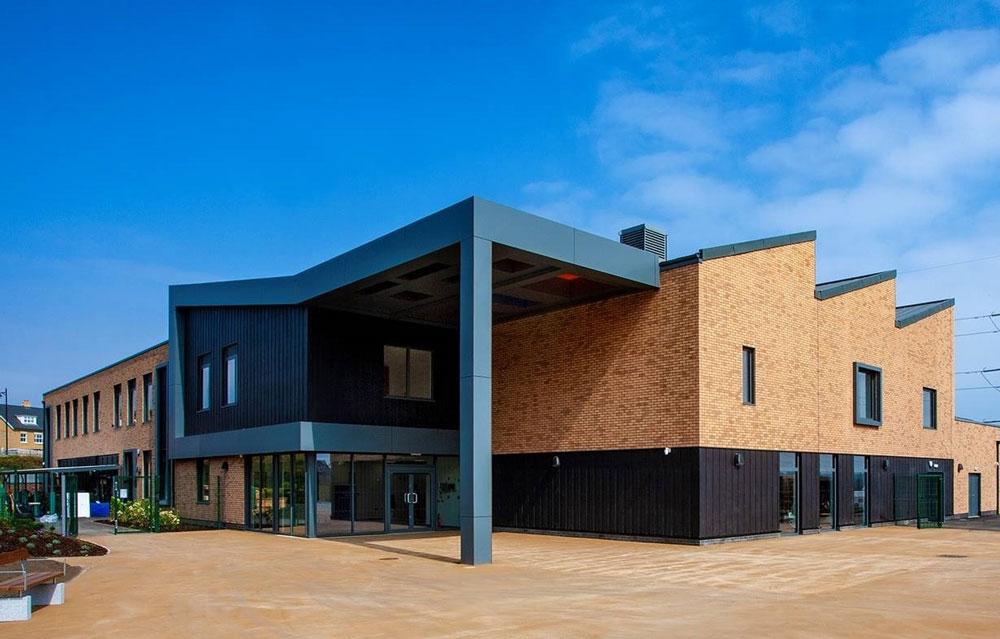
Image shows Ebbsfleet Green Primary School, Swanscombe. Image © Integra Buildings